
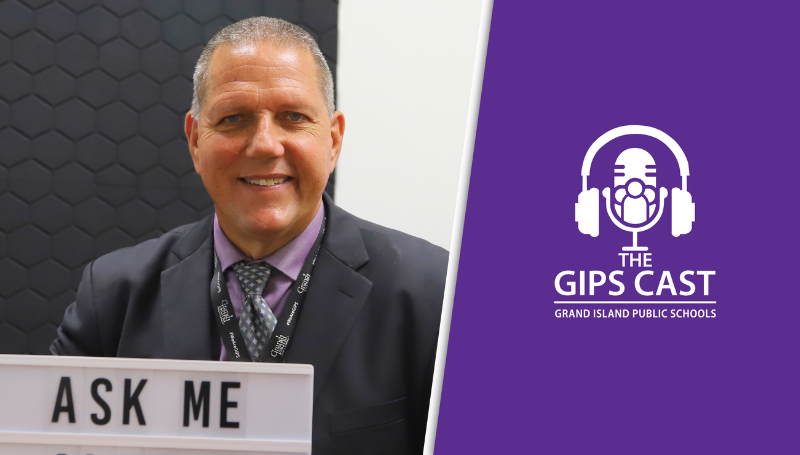
"The GIPS Cast" is back and Mr. Fisher is ready for your questions!
After taking the summer off, GIPS has relaunched their district podcast with a new video feature. Matt Fisher, GIPS Superintendent, joins the podcast for a mailbag episode.
Dozens of questions were submitted from GIPS students, staff, families, and community members. In this episode, Mr. Fisher fields a few on a variety of topics like:
- What's the process for calling snow days?
- Is GIPS ready for a second high school?
- What about a four-day school week?
- How do you define student success?
- What's the best motorcycle?
- And more
People are also reading…
Be sure to subscribe on Apple Podcasts, Spotify, iHeart Radio, or your favorite podcast platform.
Episode transcript
Matt Fisher 00:00
"I'm Matt Fisher, Superintendent, Grand Island Public Schools. Let's talk."
Mitchell Roush 00:07
"Welcome back to 'The GIPS Cast'! This is a conversation-based podcast bringing you the voices of Grand Island Public Schools in Nebraska. Now, our guest today is the big man himself, Mr. Matt Fisher, GIPS Superintendent, and he was willing to do a mailbag episode with us. Let's dive in, Mr. Fisher. Thank you for being here, and welcome back to 'The GIPS Cast'."
Matt Fisher 00:33
"Well, thanks for the invitation."
Mitchell Roush 00:35
"Always, you've got an open invitation, so you can pop on any time you want. But I do appreciate you leaning into the idea of jumping on video with this podcast. We're excited to reach more people, and you said yes to a mailbag. So yeah, how do you feel? How do you feel about the mailbag?"
Matt Fisher 00:53
"Well, you know, it's exciting. You know, I've had a chance to look at the questions and a lot of really great questions and really thought-provoking. Yeah, had to give some serious thought to how are we going to answer these questions?"
Mitchell Roush 01:09
"Absolutely. So just for our listeners and our watchers, so they know what we did. If they didn't see it, we put a form out there on social media, sent out emails to students, staff, and families, and invited people to submit questions to you, and see which ones we would have time to fit into this episode. So the cool thing about this is, is we do have questions from alum, from current students, from staff members, and from families. So you got to hear from everybody."
Matt Fisher 01:39
"Yeah, that's great."
Mitchell Roush 01:40
"All right. So let's dive in to the first one. All right. So this is from a fifth grader in our district, and this fifth grader wants to know why did you want to become an educator?"
Matt Fisher 01:54
"Well, probably it starts out with my dad being an educator, and so it was kind of like the family business. We're all teachers in this family. Yeah, yeah. Actually, I do have a brother that's an educator as well, and so yeah, it is kind of a family business. But then I think beyond that, it really was just the experiences that I had with teachers along the way as I was going through elementary and then through middle school and high school. There were just a lot of teachers that I had that made an impact on me, and along with teachers I would say also coaches. I was very involved in athletics, and having those coaches' influence was important to me as well, and I got to college. Though I wasn't planning to be an educator, I was going to be an engineer."
Mitchell Roush 02:48
"You played football too, right? Played football back in Kearney State days."
Matt Fisher 02:51
"Back in the Kearney State days, the pre-UNK days. But you know, got to about my third year of college, and decided, you know, I don't know that engineering is really what I want to do, and I had all these math and science classes, and I decided, well, you know, the family business is education, so there I am, and so ended up going out and being a math and science teacher, and eventually became a principal, and from there, you know, rolled on into the superintendent gig, you know, a little further down in my career. Yeah."
Mitchell Roush 03:26
"So now you get to make the big decisions."
Matt Fisher 03:28
"Yeah. Yeah. Some of the big decisions. Some of them."
Mitchell Roush 03:33
"And I think I've heard you say this before. Correct me if I'm wrong. You're at about 40 years in education."
Matt Fisher 03:38
"Yeah. Just short of 40 years."
Mitchell Roush 03:40
"So, a minute."
Matt Fisher 03:41
"Yeah, a year or two. So I've seen a thing here and there."
Mitchell Roush 03:46
"That's awesome. Kind of along those same lines, right? You work your way up, and you obviously have a passion for education, but the stakes and the decisions that you're responsible for making get higher as you work your way up in roles from building principal to a district administrator, right? So, as a superintendent gig, you know one of the things you get to do is decide on if we have snow days or not. Always a popular decision. Always a popular decision. There's never anyone upset about snow days, right? But it is a popular talking point. As funny as that might sound, right? I imagine you get questions about that. I know when I'm out in the community, I'll have people asking me, like, 'What's the process on snow days?' People want to know. Well, on the mailbag, we do have an alum, a former student who's in college right now, write in and ask about the process, and they want to know, as superintendent, what are the discussions and processes you have to take when calling off school for a snow day? So let's let our audience know what is the official process on a snow day."
Matt Fisher 04:51
"Okay, I don't know if it's official or not, but here's kind of what it looks like. Anytime we've got severe weather coming, we're going to get some notice from the National Weather Service. Yep. So reviewing that and really studying, you know, and they do a really nice job of mapping out what the weather system is going to look like, what the anticipated snowfall is, the timing of the events, you know, and now they're much more accurate than they were when I first got in."
Mitchell Roush 05:21
"Absolutely, the technology has gotten more reliable,"
Matt Fisher 05:24
"so that's really helpful. So that's kind of where it starts, and then, you know, about the time that happens, then I'm going to start having conversations with other superintendents in Grand Island. You know, we'll connect with the three other schools in Grand Island, and just kind of get a sense for what's everyone thinking, and then I usually also connect with Hastings and Kearney because when you think about their school settings, definitely look a lot more like us than, you know, obviously, when you're thinking about Northwest, you're trying to figure out, okay, what kind of country roads are going to be blown closed and things like that that may not impact us. You know, we have other impacts that we're going to look at. So we have those conversations with those other people, and then internally, you know, we're going to sit down with Dr. Stevens and Mr. Petch, our facilities and grounds director, and then Dan Barron, who is the person who ultimately is in charge of snow removal."
Mitchell Roush 06:30
"And my hot take is I don't think Dan Barron ever sleeps."
Matt Fisher 06:34
"No."
Mitchell Roush 06:36
"He's up checking the roads at one a.m. He's watching the weather late at night. Like he knows everything, but I don't know if he sleeps at all."
Matt Fisher 06:43
"Yeah, I'm going to guess on those days he probably doesn't because ultimately a lot of our decision comes down to can we get our parking lots opened up? Yep. You know, and the underlying thing for me in ultimately making the decision is I always feel like the best place for our students to be is here at school. Yeah, and you know that's, you know, for a lot of our students that is the place where they know they have heat and they know they have food and some of the things that, you know, are going to be question marks if we don't have school, right? And so I think my goal is always to have school if we feel like we possibly can, and we realize that there are going to be some students that aren't going to make it. You know, for one reason or another, they don't have the safe transportation, whatever. You know, I guess the thing that I always stress too is that ultimately whether children come to school or not is the decision that their parents are going to make."
Mitchell Roush 07:46
"Absolutely,"
Matt Fisher 07:46
"and we want them to make that decision, and we want them to feel safe. But again, you know, we feel like any time that we can, we're going to have school."
Mitchell Roush 07:58
"I think that's a good reminder for everyone, is we're here for the kids, and we would never make a decision that we didn't think was unsafe. But we certainly want to do everything that we can to help students feel like they belong and they've got a place to go because some students really rely on that. And another interesting wrinkle, I think, about our district is because of our size, we don't do late starts either because mobilizing transportation and everything all across the city for accommodating a late start is just kind of a logistical nightmare."
Matt Fisher 08:28
"Yeah, and I think the other thing that goes into the no late start thing is just simply that most of our families have two parents that work."
Mitchell Roush 08:37
"Yep,"
Matt Fisher 08:38
"and the most disruptive thing that there is for people that are working is to have to go to work and then come home and get kids ready for school at a later time and then get back to work, and so again I think it's just, you know, the late start just isn't something that works for us. You know, either we're going to be ready to go at the time that we normally go, or we're not going."
Mitchell Roush 09:02
"Fair enough. There it is—the definitive snow day answer. So now that's out there for everyone to know. But that's a great question, and again, a lot of thought and collaboration goes into making that decision every time. Every time. Let's shift gears a little bit, and one thing I was encouraged about with this mailbag is one of the things I know that you've been wanting to talk about and have been talking about quite a bit over the last year is the future of Grand Island, more specifically the growth of Grand Island Public Schools, and what are we going to do with Grand Island Senior High, and do we need a second high school, and that is not a secret. That has been out there for everyone to know. And I know you've been curating that conversation as much as you can in our community. And I'm encouraged because we actually had three different people reach out on the mailbag and ask similar questions all around the second high school idea, and one question was from a current high school student, which I thought was pretty cool. One is from a parent, and one is from an alum. So, kind of a lot of different representation there. Let's dive into that piece right now. Specifically, the questions we got were talking about: What are we thinking in terms of a second high school? If we are thinking about one at all, how does that affect bond campaigns in the future? What's your take on if we're going to do a second high school or not? So, where are we at with that right now?"
Matt Fisher 10:31
"Well, you know, I think we are, as you said, in the conversation stage right now. I think having a second high school, what that second high school could look like or should look like, is really something that needs to be driven by our community. Yeah, you know that's not an internal decision for us to make. That's something that our community really needs to lead us to, because I think there's strong feelings there. I think there are some people out there that very much feel like we're at the size that we really need a second high school. I think there are other people out there that really feel like, you know, we want to keep a one-high-school setting, that everyone should be an Islander, and you know, that's where they feel like we need to stay. So I think there's some pretty strong feelings on both sides of that, and in the end, the answer, you know, may be both. Yeah, you know, maybe it is we put a full second campus together, but maybe everyone still is an Islander. You know, because when we start looking at activities, and obviously activities are going to be a driving factor in whatever decision gets made, maybe it makes more sense to keep everything together under one, you know, one activity group rather than saying we're going to have, you know, Grand Island East and Grand Island West or North and South, or whatever it would be, and, you know, having different teams. Again, I think our community has to drive that decision process."
Mitchell Roush 12:14
"It's been interesting to hear because I've been in the room with some of your presentations and conversations you've had with community folks around this topic, and I think you hit the nail on the head. There is a long-standing pride in our community of we've been Islanders and only Islanders in our district for such a long time. But, you know, just for context, you know, we are one of the largest high schools in the state of Nebraska, and so when we start talking about growth 20, 30 years from now, you have to think about how big is too big, right? And I think there's merits to both sides of the conversation. Do you want to talk a little bit about some of the ideas we've heard floated out there about CPI? Because we do have a second facility that we're utilizing right now, and there's also some opportunity there."
Matt Fisher 12:58
"And I think that's one of the possibilities that I think certainly needs to be looked at, is do you expand CPI out to being a full technical high school? And I think there's certainly some merit to that, and I think it's something that would be very doable. But is it what our community wants? I don't know that we have an answer to that yet. But I think that's, you know, as we go through, you know, the process that we did last year, really trying to think about, well, what is the next 50 years for Grand Island Public Schools look like? I think there's going to be a lot of discussion around, well, what is the high school answer? It's the tipping point. I think the other pieces in that puzzle are pretty easy to figure out where they fit, and eventually, you know, you have growth, and in that area, you need to add an elementary building, and, you know, your middle schools get to a certain size, and you need to add some capacity there. Those are all pretty easy things to answer. The high school question is the hard one."
Mitchell Roush 14:06
"It's the hard one. Since we're putting this on video and we're going to be blasting it out there, what's your invitation look like to folks in the community that are watching this to talk to you or to board members if they want to get involved or share ideas?"
Matt Fisher 14:19
"Yeah, I think absolutely. You know, I think we put together a long-range plan. It's a three-phase plan that we're working our way through. We started on that this year, but it's certainly not a plan chiseled in stone by any means. It's a plan that's very open to, you know, what are the right steps, and what are the right things to put in place? You know, and I know the other part of that question about the high school was, you know, is it going to be part of a bond campaign? Yeah. Well, in that three-phase plan, yes, there was, you know, in phase three, which we're thinking about as being somewhere in that 15- to 20-years-out range, that was part of the plan, was a second high school building."
Mitchell Roush 15:09
"That way we could at least get the numbers out there, right? Like it's—I mean, I don't know if this is a surprise to anybody. It's not cheap to build a second high school."
Matt Fisher 15:17
"You know, to do a true full second high school, you're probably, I mean, you know, and especially if you're talking about 10 years from now or 15 years from now, you're 150 million plus. Yep, and that's going to the public and saying we're going to increase your taxes significantly in order to build a second high school, and so I think that's, you know, that's obviously a big part of the figuring-the-right-answer-out because in the end, if the community isn't telling us what we want, the community is going to tell us in a bond election what they don't want. Absolutely. And so I think it's really important to try and get, you know, get that narrowed down to something that people can get behind and say, yes, this is what we want for our future going forward."
Mitchell Roush 16:08
"Absolutely. So I know that you're an open book. I know our board members are an open book right now, facilitating conversations and garnering ideas. So definitely, folks can reach out to you, reach out to board members, or come to any events that we're hosting in the near future to share with us what do they want to see with the high school in the future?"
Matt Fisher 16:28
"For sure."
Mitchell Roush 16:28
"Yep. All right. So that's the big-picture question, you know, long-term planning in the future. We did get some really good questions about, you know, kind of right now and maybe a year from now in terms of student support, vision, and opportunities, and so I want to dive into that with you for a little bit. I really like this question. We got a question from a senior at Senior High who said, 'How do you define a successful student when they walk across the stage at graduation?'"
Matt Fisher 16:58
"Well, I think the bottom line for that question is simply: they're prepared for life. You know, they are successful in what we want to do with them to that point if they are prepared for their life beyond that, you know, and so I think when you think about being prepared for life, do they have the skills? Number one, one of our strategic plan pieces is, do they have a plan? Absolutely. You know we want 100% of our students leaving to have a plan for what they are going to do next. Now we know that life changes."
Mitchell Roush 17:32
"Yeah,"
Matt Fisher 17:33
"and so we also, you know, when we think about those skills, we want them to be adaptable to those changes that come their way, so I just think that prepared for life is the bottom line for that. You know, in life, obviously that might be they're prepared to go to college, that might mean they're prepared to enter the workforce, they're prepared to go into the military, or they're prepared to raise a family. I think those are all things that are really important—that we make sure that our students leaving us have the skills and the plan for how they're going to shape their life."
Mitchell Roush 18:12
"Enrolled, employed, or enlisted is what I always come back to. And again, that's how do you wrap your arms around that abstract concept of successful. I think that's a great way to capture it, is if you're done with high school and you're walking across that stage at graduation, do you know what you want to do next, and do you have the skills to confidently pursue it? And if we're doing that for our kids, then I think we're doing okay."
Matt Fisher 18:36
"Yep."
Mitchell Roush 18:36
"Right. So continuing down that same path here, what do you see as the biggest opportunity for our schools right now? We had another high school student ask that question."
Matt Fisher 18:47
"I think the opportunity that we have that really sets us apart from other schools is the diversity, and I really think that is such an opportunity because it gives our students a chance to be exposed to cultures from all over the world, and really does—you know, we talked about me being in this business for 40 years. At one time, we were pretty isolated, yeah, in what we were doing as a state, as a nation; we didn't have the diversity and the connections that we have globally that exist now."
Mitchell Roush 19:30
"And so I think having our students have that opportunity to be exposed to global ideas, to be exposed to the cultures that exist in other parts of the world, I think is a huge opportunity, and I think we do a good job of embracing the diversity, and so I think that's a unique opportunity that we have that I think is really special for us. It definitely makes us Grand Island Public Schools, and the phrase that I hear throughout the district a lot is 'We have the world here at Grand Island Public Schools.' This is kind of what we're known for, and I love that. And you know, I think in our last annual report, it was over 40 languages of origin spoken in our district, which again speaks to what you're talking about, which is really cool. I know you and I just last week had the opportunity to attend the Hispanic Heritage Fiesta at Lincoln Elementary and watch all of our students put on traditional garb and do traditional dances for their neighborhood and their families. It was really cool to see, and that's one snapshot of this is our everyday life here at GIPS. Another student-focused question. We had another high school student ask, 'What is one message you want every student at Grand Island Public Schools to hear today?'"
Matt Fisher 20:48
"Well, I think the message really is that to be successful in life, you need to show up and you need to work hard, and it's probably about as simple as that. Show up and be ready to work hard. Yeah, and I think if you do that, no matter what it is that you're trying to be successful at in life, I think, you know, those are key elements. You got to be there. Yeah, you got to be there, and ideally you're there on time. Absolutely. And I know that's a challenge that we talk to employers about all the time, is having people show up and be on time, and then once you're there, you know, putting your best effort into it. Absolutely, work as hard as you can at it, and so that's true whether you're talking about a job, it's true whether you're talking about your family. I think 'show up, work hard' is a pretty good message for just about anything."
Mitchell Roush 21:48
"We could put that on a billboard. I think that's pretty solid, and as obvious as it sounds, right? I think it's a helpful reminder for everybody that's involved in the work of educating our community's children, which is students are going to learn at their best if they're at school,"
Matt Fisher 22:05
"for sure."
Mitchell Roush 22:06
"That's how it goes. Let's pivot to some staff questions, staff-related questions a little bit. We did have one staff member write in and ask if we're considering a four-day school week in the near future at all. I know that that's something that in pockets of the country has become kind of a popular talking point. So, what's your take on GIPS and a four-day work week?"
Matt Fisher 22:29
"Well, I don't see it probably happening anytime soon. Again, going back to the idea that we've got most of our families in two-parent working situations, and if we go to a four-day work week, that's one more day that they have to figure out childcare for. Childcare is something we don't have an abundance of, right? We have a great lack of already. So I think there's some real challenges from that standpoint to looking at a four-day week. You know, if all we were dealing with was middle and high school students, and you didn't have to worry about what was going to happen with, you know, that time when they're away, you might think about it, you know, a little stronger. But I just think that right now in the community that we're in, it would be really difficult to go to a four-day week."
Mitchell Roush 23:26
"And there's just, there's so many layers, kind of like the snow day thing, right? Like there are so many layers that go into making a decision that big, and those are all the things you have to consider."
Matt Fisher 23:38
"Yeah, it is, you know, and obviously there's some real appeal to a four-day week. You know, I think when we're struggling with staffing and, you know, you can put a four-day week out in front of people, that some people are going to say, oh, well, I'll go to Grand Island because they have a four-day week, and, you know, that's—like I said, there's some appeal there, but in the end, I think it creates too much of a burden for our community for us to say that's the right direction for us to go."
Mitchell Roush 24:10
"Understandable. So we've got two questions that are kind of related, so I'm going to lump them up together, and they both came from students. But it's an interesting perspective because I think it talks about student experience, but it's also directly connected to how are we supporting our staff and what do we expect from our staff. So the two questions are: What is one major goal or exciting new plan you have for the district, and what do you want to accomplish by 2027? I feel like those questions are kind of connected."
Matt Fisher 24:40
"You know, I think one of the major pieces for us this year is the Gates construction project."
Mitchell Roush 24:48
"It's a big one."
Matt Fisher 24:49
"Because that is the kickoff of our long-range planning. You know, obviously that project in and of itself is very important. You know, it's addressing a need that's existed for some time. Actually, it's a need that's probably existed since that building has existed because they didn't—"
Mitchell Roush 25:08
"Have a cafeteria. The only school in the district that didn't have a cafeteria."
Matt Fisher 25:14
"So, adding that cafeteria, adding the classroom space, and then doing the total refresh of the building really is just going to bring it, you know, up to a level that's comparable to our other buildings, and so I think that's an important piece, but I think it's also important because it does kick off the multi-year long-range plan that our board worked hard to put together last year, so I think it's a start of that, and so I think that's really important, and, you know, you think about a goal for this year, that's, you know, I think getting that done and having that part of the facility planning underway, I think, is really important. You know, I think when you talk about the other things, I think you go right back to our strategic plan. You know, we want 80% of our students to be performing at or above the average growth for academic performance. You know, I think that's critical. We want our students to perform at as high a level as possible, and, you know, we know. Again, we go back to the challenges with our diversity. You know, there are some things that make it difficult for us to look in terms of performance like everyone else. So when we think about performance, what we're really looking at is: Are we growing? Are we moving our students at a higher-than-average rate? And so I think that's really important for us to have that goal and work towards that as we think about what do we want to accomplish in 2027 and 2028 and 2020—you know, I think right on down the road. So, you know, there's obviously that one, and then tied right to that is our attendance goal—our 90% attendance goal. You know, having our students miss, you know, eight days or less during the year. That's really what our attendance goal looks like."
Mitchell Roush 27:23
"It's huge, but like we talked about earlier, like those two things are connected. I don't think you can have one without the other. I don't think we can accomplish the level of student growth that we hope for our students without them being here, and vice versa."
Matt Fisher 27:37
"Yeah, you know, and then obviously we talked a little bit about that plan, the 100% plan. We want 100% of our students to leave here with a plan because having the skills is one thing, you know, knowing how to put those skills in action is another thing, you know. And I guess that, you know, I'm optimistic about our ability to do all of those things because we have such a great staff. Yeah, you know, I think the work that our staff does, you know, with our students is just phenomenal. And again, we've stressed to our staff—not just our teaching staff, not just our para educators, but really all of our staff—how they can impact, you know, the attendance goal, how they can encourage attendance, how they can encourage, you know, the academics, how they can help model some of the skills that we want our students to develop. I think we can make all of those goals a reality because of the people that we've got working with our students."
Mitchell Roush 28:40
"I couldn't have said that better myself. We've got incredible educators and support staff in this district that are dedicated to just taking care of students and taking care of each other, and it's cool to see. One question we received is: Being a superintendent, was it what you thought it would be? And I know you've been in this gig for a little bit. You were superintendent before you came here as well too. But like, is it what you thought it would be?"
Matt Fisher 29:03
"Well, I think for the most part, yes. The good thing is I had 18 years in education as a teacher and then as a principal to kind of study that whole superintendent gig before I jumped into it. So I, you know, I kind of knew what I was getting myself into when I first became a superintendent. Then right away I found out there were a whole lot of things that I didn't know. You know, you step into a role that you've looked at for a while and you think, ah, yeah, I know how to do that. And then you figure out, ah, you know, there's a lot of things I didn't know about this job. Maybe not, maybe not. But I think overall, it's been most of what I've thought it would be, you know. And this is, you know, the third district that I've been the superintendent in. I always tell people I really had no intention of being in a district the size of Grand Island. I grew up in a small community. I went to a small school. I started teaching in a small school, and, you know, I really hadn't envisioned that, but again going back to the great people that we have, it has been, it's been a real pleasure to be here, and so I think overall I'd say yes, the superintendent role was a lot of what I expected it to be, but I think it's been a very rewarding place to be in terms of the superintendency."
Mitchell Roush 30:31
"And I think most people would agree it feels like it's been a good fit. That again may not have been in your master plan to be in a big district, but it does, it does feel like you belong here, and it feels like people are responding to the way you're wanting to help be careful with our finances and vision the growth of the district, and it feels like we're all kind of going in the same direction."
Matt Fisher 30:56
"Yeah, I think so. I think it has been, like you said, a good fit."
Mitchell Roush 31:01
"Yeah, absolutely. So, Mr. Fisher, I'm going to ask you—well, I've asked you this before because you've been on the podcast before. But I ask every guest, every episode, this question because I just, I love the answers that our people come up with, students and staff alike. So, what's one thing about public education you want people to know?"
Matt Fisher 31:20
"I would say that what I really would want them to know is that there are tremendous people that are making public education work."
Mitchell Roush 31:32
"Yeah,"
Matt Fisher 31:33
"and again, when I say tremendous people, I mean top to bottom,"
Mitchell Roush 31:39
"everybody."
Matt Fisher 31:40
"You know, whether that's the support staff, the people that are working with our students in the classrooms, the administrators. There are some great, great people that are working really hard to make sure that our students are successful,"
Mitchell Roush 31:54
"and that makes all the difference."
Mitchell Roush 31:56
"We get the pleasure of being able to slip in and out of classrooms all the time and see that in action, but I do think that that's the one thing that's always going to stay the same, which is our people are going to do great things for students. Final question before we sign off, because I think our viewers would want to know, and I definitely want to know. All right, so motorcycle—yeah, your bike, you're a bike guy. Yeah, you take your bike out any chance you get; you will even drive it on a stage or in a gym if you get the opportunity, right? So, are you brand loyal or do you have different brands of bikes? So, like, how do you—what's a good bike?"
Matt Fisher 32:33
"Well, a Harley."
Mitchell Roush 32:35
"All right,"
Matt Fisher 32:36
"and you know that's really a funny question because back, the first vehicle I owned was a Kawasaki motorcycle."
Mitchell Roush 32:47
"Oh, okay. That's where you got your start."
Matt Fisher 32:49
"And I had that, and then at one point in time, some of my friends had some street bikes, and I remember the day I graduated from high school. One of my friends had this nice new street bike. It was a Honda."
Mitchell Roush 33:05
"Okay."
Matt Fisher 33:05
"And I drove that, and I thought, all these people with these Harleys, they think they're, you know, that that's all this, and you're like a hipster bike guy. If I could just have a bike like this, I would be so happy. Well, then I rode a Harley."
Mitchell Roush 33:22
"Everything changed. Harley for the win. All right, that's the important info that people really needed to know: Mr. Fisher's a Harley guy. All right, awesome, Mr. Fisher. Thank you so much for being here."
Matt Fisher 33:38
"You're very welcome."
Mitchell Roush 33:40
"So that's it for this episode of 'The GIPS Cast'. Thank you so much, listeners, for joining us here. We wouldn't be here without you. If you enjoyed this episode, give us a rating or review on your favorite podcast platform, and explore our backlog of episodes on our website gips.org. Thank you again to Mr. Fisher for being our guest today, and we will be coming back at you soon with some more great stories from our district."